 San Jose Morgan Hill
 in San Jose & Palo Alto
A deep plane facelift addresses facial aging where much of it actually occurs: beneath the skin, within the deeper tissues that support the cheeks, jawline, and lower face.
Rather than relying primarily on skin tension to create a lift, deep plane facelift surgery releases and repositions deeper facial tissues as a connected unit. This allows the surgeon to address changes such as midface descent, jowling, loss of jawline definition, and facial laxity while aiming to preserve natural expression and facial identity.
At Illuminate Plastic Surgery, David Boudreault, MD, FACS, performs deep plane and SMAS facelift surgery for patients in San Jose, Palo Alto, Silicon Valley, and throughout the San Francisco Bay Area.
His experience with these techniques and facial anatomy ultimately led him to develop the Deep-ER Facelift™, his proprietary extended deep plane approach.
A deep plane facelift is a facial rejuvenation procedure that works beneath the SMAS, a strong layer of connective tissue associated with the muscles and soft tissues of the face.
The face does not age only because the skin becomes loose. Over time, deeper facial tissues can descend. The cheeks may flatten or move downward, folds around the mouth may become more noticeable, jowls can develop along the jawline, and the distinction between the lower face and neck may become less defined.
Retaining ligaments help anchor facial soft tissues to deeper structures. Deep plane facelift surgery releases selected retaining ligaments so descended tissues can be mobilized and repositioned more freely.
Release the deeper tissues, reposition them, and allow the skin to redrape over the new underlying support.
The objective is structural rejuvenation rather than simply pulling the skin tighter.
Facial aging is a combination of changes involving the skin, fat, connective tissues, ligaments, muscle, and underlying facial structure.
One particularly important change is tissue descent. The retaining ligaments of the face act as relatively fixed attachment points. As surrounding facial tissues descend with age, those relationships change.
In the midface, cheek tissues may sit lower than they once did, contributing to flattening of the upper cheek and greater prominence of the nasolabial folds. Along the lower face, descended tissue contributes to jowling and loss of a clean jawline.
This is why adding volume or tightening skin alone does not solve every aging concern. Sometimes the underlying issue is not simply that tissue has disappeared—it is that tissue has moved.
Deep plane surgery is designed to address that deeper structural component of facial aging.
Both SMAS and deep plane facelifts can produce excellent results in appropriately selected patients. The primary difference is how the deeper facial tissues are accessed, released, and repositioned.
In a traditional SMAS facelift, the surgeon works with the SMAS layer to improve facial laxity. The exact technique and degree of deeper release vary considerably among surgeons.
A deep plane facelift works beneath the SMAS and releases key retaining ligaments, allowing the SMAS and associated facial tissues to move together as a unit.
That increased mobility can be particularly useful when treating midface descent, jowling, and loss of jawline definition.
Neither name automatically makes one operation superior to another. Facelift surgery is highly technique- and surgeon-dependent. The appropriate approach depends on the patient's anatomy, degree and location of facial aging, previous procedures, skin quality, goals, and the surgeon's experience.
The Deep-ER Facelift™ is David Boudreault, MD, FACS's proprietary approach to extended deep plane facelift surgery.
It builds on the principles of a deep plane facelift with an Extended Release of the retaining ligaments through the midface, Enhanced Reshaping of the cheek, using the SMAS flap folded over the zygomatic bone, and Elevated Results in the neck, because the freed flap adds real lifting effect.
Not every patient needs every component of the Deep-ER technique. The extent of release, neck work, and optional cheek reshaping is determined by the individual's anatomy.
Midface Descent. As the tissues of the cheek descend, the upper cheek can appear flatter while fullness becomes more noticeable lower on the face. Repositioning deeper midface tissues can help restore a more youthful relationship between the cheek and lower face.
Jowls. Jowls develop as facial tissues descend across the jawline. A deep plane facelift can reposition these deeper tissues and improve the transition between the face and neck, creating greater jawline definition.
Loss of Jawline Definition. Facial descent, skin laxity, and neck changes can blur a jawline that was once more distinct. Facelift surgery addresses the underlying facial component while the neck is evaluated separately to determine what additional treatment, if any, is needed.
Nasolabial Folds. Midface descent can contribute to deepening of the folds that run between the nose and mouth. Repositioning the midface may soften these folds, although a facelift does not erase every facial line or crease.
Facial and Neck Laxity. The lower face and neck frequently age together. For patients with both facial descent and neck laxity, Dr. Boudreault evaluates the face and neck as connected anatomical areas and determines which components should be addressed during surgery.
A facelift is powerful, but it does not correct every sign of facial aging.
Deep plane facelift surgery does not directly treat significant upper- or lower-eyelid aging, brow descent, sun damage or pigmentation, fine surface lines and skin texture, every type of facial volume loss, or all anatomical causes of neck fullness or laxity.
Depending on the patient, eyelid surgery, brow surgery, laser resurfacing, fat grafting, or other procedures may be considered separately.
Dr. Boudreault's goal is not to stack procedures unnecessarily. It is to identify which anatomical changes are actually responsible for what bothers the patient and address those changes appropriately.
A well-planned deep plane facelift is intended to avoid an excessively tight or “wind-swept” appearance.
Because the deeper facial tissues are released and repositioned, the lift does not need to depend primarily on excessive tension placed on the skin.
Once the deeper tissues are repositioned, the skin can be redraped over the underlying structure and excess skin removed as appropriate.
Dr. Boudreault's objective is not to create a different face. The goal is to restore more youthful facial relationships while preserving the features, expression, and identity that make the patient recognizable as themselves.
Candidates for deep plane facelift surgery generally have enough structural facial aging to justify a comprehensive surgical lift.
You may be a candidate if you have midface or cheek descent, jowling, loss of jawline definition, facial and/or neck laxity, deepening facial folds related to tissue descent, multiple connected signs of facial aging, good overall health, and realistic expectations about surgery, recovery, and results.
Candidacy is determined by anatomy rather than a checklist alone. Previous facial procedures, skin quality, medical history, nicotine exposure, healing history, and the location and degree of facial aging all influence the surgical plan.
There is no single best age for a deep plane facelift. Anatomy matters more than a specific birthday.
People develop facial aging at different rates because of genetics, facial structure, skin quality, sun exposure, weight changes, lifestyle, and other factors.
One patient may develop meaningful jowling and neck laxity earlier than another person who is considerably older.
The better question is not, “Am I old enough for a facelift?” It is, “Have the deeper tissues of my face changed enough that a facelift is the most appropriate way to address what bothers me?”
If the answer is no, Dr. Boudreault may recommend a less extensive procedure—or no surgery yet.
Every facelift begins with an assessment of the patient's individual facial anatomy.
Dr. Boudreault evaluates where facial tissues have descended, where they remain tethered, the shape and position of the cheeks, the degree of jowling, the jawline, skin quality, and the anatomy of the neck.
Facelift incisions are generally placed around the hairline and natural contours of the ear and continue behind the ear into the scalp.
Through these incisions, the deeper facial tissues are accessed and the planned retaining ligaments are released. The mobilized tissues can then be repositioned according to the patient's anatomy.
The skin is subsequently redraped over the repositioned deeper tissues, excess skin is removed as appropriate, and the incisions are carefully closed.
The specific operation varies from patient to patient. A consultation is necessary to determine the appropriate extent of facial release, repositioning, and neck surgery.
A deep plane facelift and neck lift address different but closely related anatomical areas, and they are frequently performed together when both the face and neck show meaningful aging.
A facelift primarily addresses descended facial tissues and jowling. Neck surgery may address loose skin, deeper support, muscle changes, excess fat, or other anatomical contributors to an aging neck.
Because these problems differ from patient to patient, there is no single neck procedure that should automatically be performed with every facelift.
Dr. Boudreault evaluates the cheek, jawline, and neck as a continuous aesthetic unit and determines which components are necessary for a balanced result.
His Deep-ER Facelift™ also allows the released SMAS flap to contribute to lower-face and neck support when appropriate.
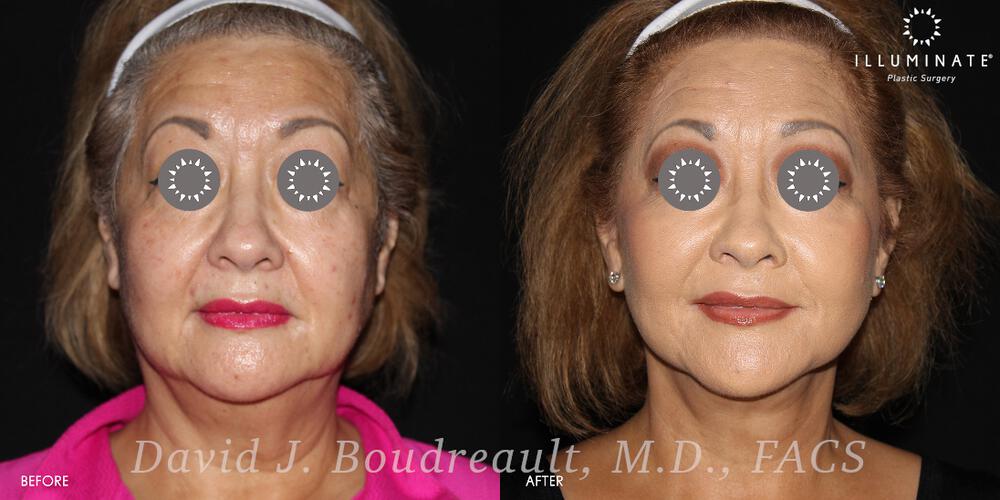
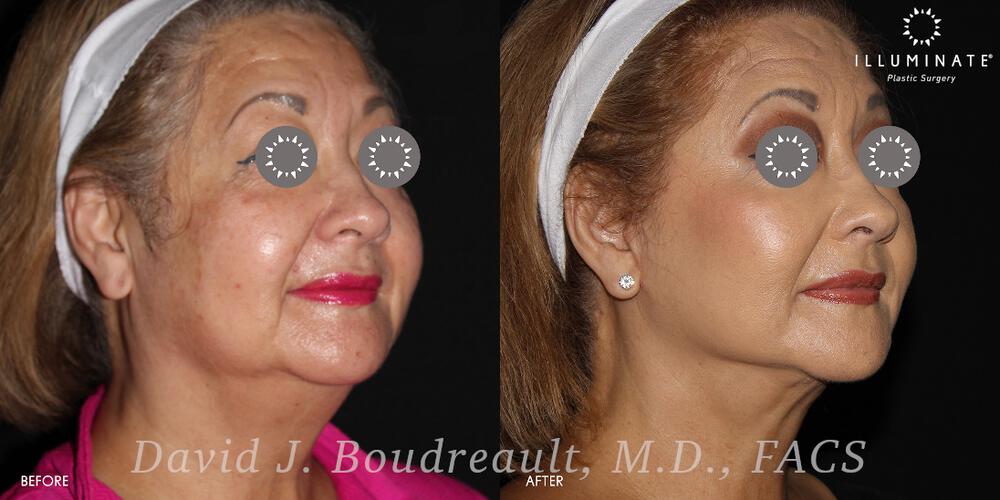
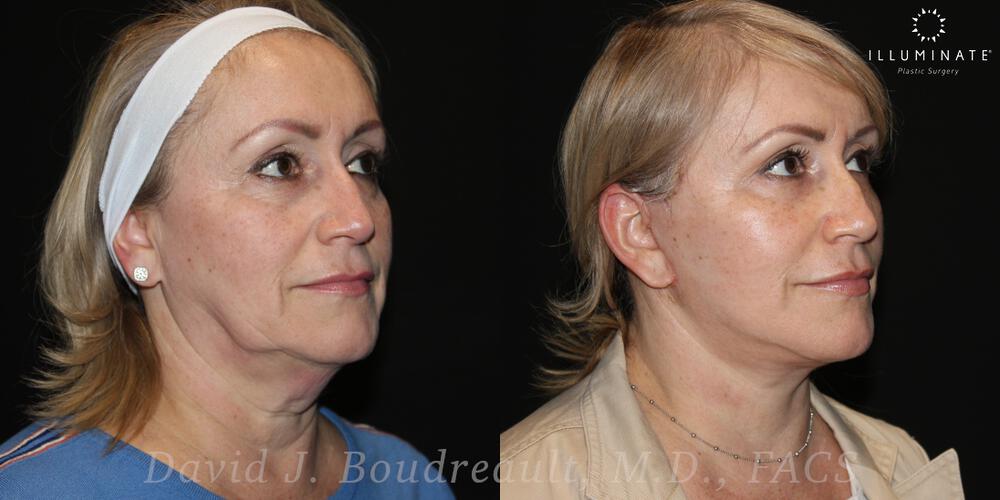
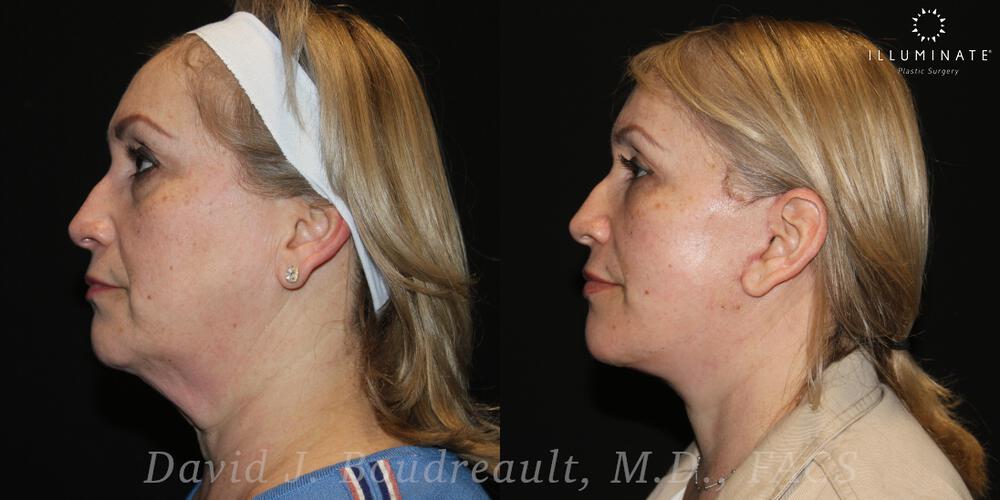
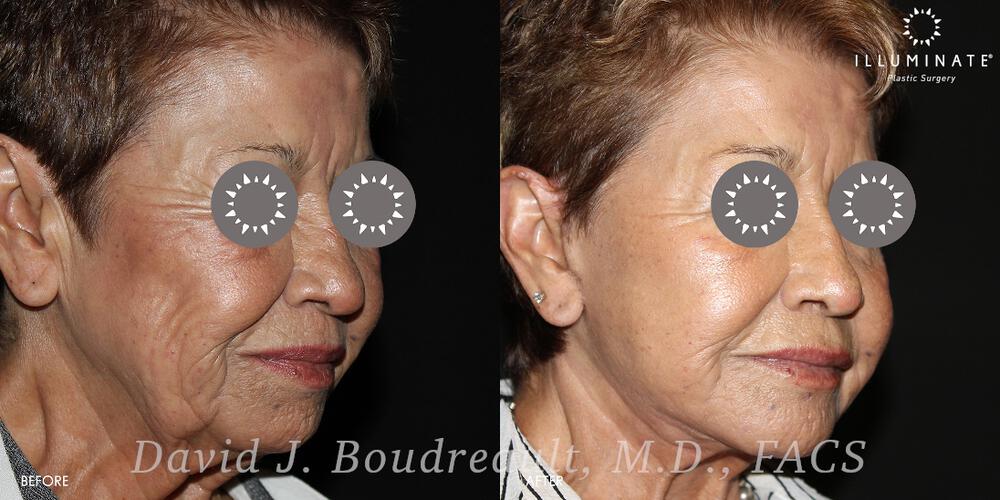
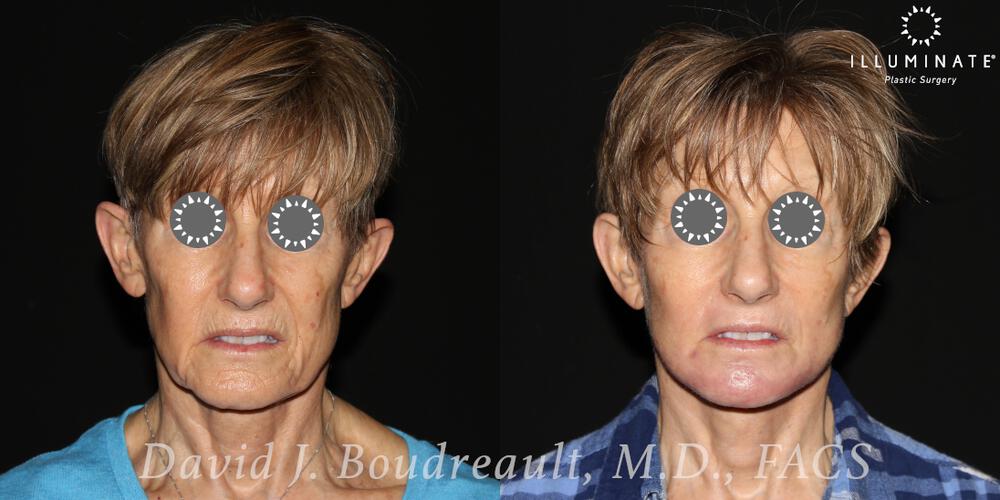
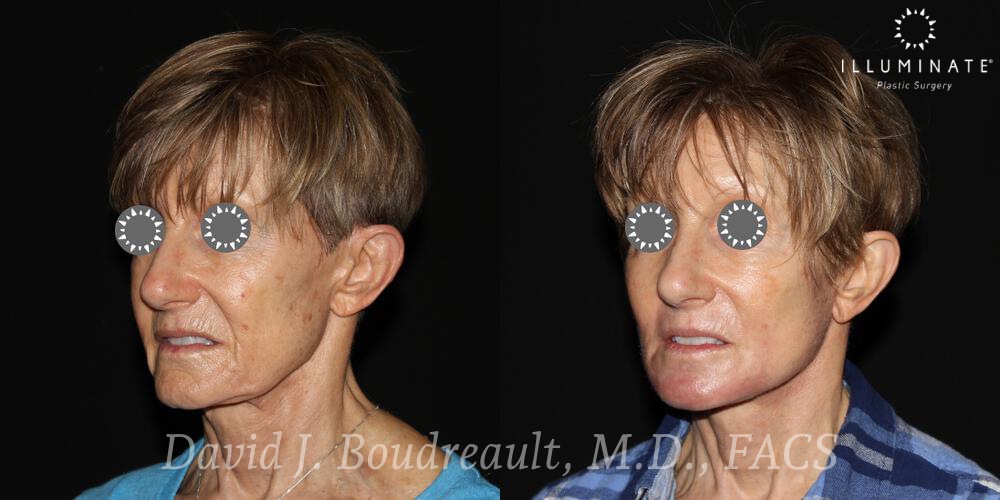
Facelift results are best understood by looking at actual patients rather than relying only on descriptions of a surgical technique.
Each patient shown here was evaluated according to their individual facial anatomy, degree of aging, and goals.
For maximum transparency, each case should identify: Primary concerns • Procedure performed • Meaningful additional procedures • Time since surgery
 Swipe To Next
Recovery varies according to the extent of surgery and the individual patient's healing.
Swelling, bruising, tightness, and temporary numbness are common during the early stages. Many patients find swelling and bruising more noticeable than discomfort.
Most patients feel comfortable returning to public or social activities in approximately two to three weeks, although this is not the same as being completely healed.
Residual swelling and subtle changes can continue to improve over the following months as the tissues settle.
Dr. Boudreault provides individualized instructions regarding incision care, sleeping position, work, exercise, social activities, and the gradual return to normal activity.
A deep plane facelift is designed to create long-lasting structural improvement, but no facelift stops the natural aging process.
After surgery, the face continues to age from its new starting point.
How a facelift changes over time depends on the patient's anatomy, genetics, skin quality, sun exposure, weight fluctuations, nicotine exposure, lifestyle, and other factors.
For that reason, it is not appropriate to promise the same number of years for every patient.
Facelift incisions are typically placed along the hairline and natural contours around the ear and continue behind the ear into the scalp.
These locations are selected so mature scars can be as inconspicuous as possible.
Scar quality varies according to genetics, skin type, surgical plan, incision care, healing, and nicotine exposure.
Dr. Boudreault will show you where your incisions are expected to be located as part of your surgical consultation.
A deep plane facelift is a significant surgical procedure and carries potential risks.
Depending on the patient's procedure and medical history, risks may include bleeding or hematoma, infection, fluid accumulation, delayed wound healing, unfavorable scarring, temporary or permanent sensory changes, asymmetry, skin-healing problems, changes around the hairline or incisions, injury to facial nerve branches, anesthesia-related complications, and the possibility of revision surgery.
Nicotine can significantly interfere with circulation and wound healing and must be discussed honestly before surgery.
Dr. Boudreault reviews the potential benefits, limitations, alternatives, and patient-specific risks before surgery so patients can make an informed decision.
David Boudreault, MD, FACS, is a board-certified plastic surgeon and founder of Illuminate Plastic Surgery.
He completed general surgery training at UCSF East Bay and plastic and reconstructive surgery training at UC Davis Medical Center.
His approach to facelift surgery has developed through years of performing SMAS facelifts, studying deep plane techniques and facial anatomy, and evaluating why individual faces age differently.
For Dr. Boudreault, choosing a facelift technique starts with identifying what changed anatomically: Has the cheek actually lost volume, or has tissue descended? Where is the midface tethered? What is creating the jowl? How much of the aging appearance comes from the face versus the neck? Which structures need to be repositioned? And equally important: what does not need to be changed?
That philosophy ultimately led Dr. Boudreault to develop the proprietary Deep-ER Facelift™, his extended deep plane approach.
There is no standardized operation performed identically on every patient. The surgical plan is adjusted according to anatomy, previous procedures, degree of aging, and the patient's goals.
If a smaller procedure—or waiting—is the more appropriate choice, Dr. Boudreault will say so.
No. Facelift surgeons use different techniques based on their training, experience, surgical philosophy, and the patient's anatomy. Deep plane facelift surgery involves dissection and ligament release within deeper facial tissue planes near important anatomical structures, including branches of the facial nerve. Experience with facial anatomy and the particular technique being performed is therefore an important consideration when choosing a surgeon. Dr. David Boudreault performs SMAS and deep plane facelift surgery and developed the Deep-ER Facelift™ as his extended deep plane approach.
Not necessarily. There is no single facelift technique that is best for every patient. Both SMAS and deep plane approaches can produce excellent results when appropriately selected and performed. The better question is which technique best addresses your anatomy and pattern of facial aging.
Yes, jowling is one of the common concerns addressed by facelift surgery. Jowls develop in part as facial tissues descend across the jawline. Repositioning deeper facial tissues can improve the jawline, although the degree of improvement varies according to anatomy, skin quality, and the surgical plan.
It may. Midface descent can contribute to deeper nasolabial folds. Repositioning descended midface tissues may soften them, but facelift surgery does not erase every line or fold around the mouth.
A standard deep plane facelift primarily repositions existing facial tissues rather than adding new volume. In some patients, simply restoring descended cheek tissue to a more youthful position improves the appearance of upper-cheek fullness. With Dr. Boudreault's Deep-ER Facelift™, an optional SMAS-fold technique may also be used when additional cheek width or projection would improve facial balance.
Not necessarily. A facelift and dermal filler address different anatomical problems. Repositioning descended facial tissue may reduce the need for volume correction in certain areas, while some patients may still benefit from carefully selected filler or other treatments later. The goal is not to add volume automatically, but to determine what is actually causing the concern.
Often, yes, but previous treatments can affect the anatomy and surgical plan. Tell Dr. Boudreault about previous facelifts, threads, filler, fat grafting, implants, energy-based treatments, and other facial procedures during your consultation.
Many patients feel comfortable returning to public activities in approximately two to three weeks. Swelling continues to improve after that point, and the final refinement of the face can take several months. Your individual recovery depends on the extent of surgery and how your body heals.
The timing depends on your operation and healing. Patients return to activity gradually and should not resume strenuous exercise until cleared by Dr. Boudreault. You will receive an individualized postoperative schedule.
The cost of a deep plane facelift depends on the extent of facial and neck surgery, additional procedures if appropriate, anesthesia, and facility fees. Because facelift surgery is individualized, accurate pricing requires an examination and surgical plan. Illuminate Plastic Surgery provides detailed pricing and financing information after your consultation.
If you are considering a deep plane facelift in San Jose, Palo Alto, Silicon Valley, or the San Francisco Bay Area, a consultation with Dr. David Boudreault is an opportunity to understand what is actually contributing to the changes you see in your face.
The goal of the consultation is not simply to decide whether you “need a facelift.” It is to determine what has changed anatomically, which changes are actually bothering you, what should be repositioned, restored, or left alone, and what is the least extensive operation that can appropriately accomplish your goals.
Dr. Boudreault will evaluate your face and neck, discuss your priorities, and explain which surgical approach—or waiting—makes the most sense for you.
Illuminate Plastic Surgery | San Jose & Palo Alto, California
Every patient is different. Anatomy, skin quality, healing biology, medical history, previous procedures, lifestyle factors, and other variables influence what facelift surgery can achieve and how an individual's result changes over time.
Before-and-after photographs and descriptions demonstrate individual patient outcomes and are not guarantees of a specific result.
During your consultation, Dr. Boudreault will discuss the expected benefits, limitations, risks, alternatives, and realistic goals of surgery based on your individual anatomy.
Trust is our Best Feature
At Illuminate we’re with you during every step of your journey toward greater self-confidence. Schedule a consultation with us today and let Illuminate’s expert team listen to your concerns and guide you through treatments and procedures to help you reach your individual goals. We look forward to seeing you and celebrating your renewed appearance and realized potential.